
10 Best Retail Media Agencies to Watch in 2026
Retail media will cross $200 billion in 2026, but a bigger budget does not guarantee more sales. As growth slows and measurement gets harder, the agency you pick decides whether your money drives revenue or disappears into vanity metrics. Here are ten worth watching.
Retail media remains one of the fastest-growing segments of digital advertising. Global spending is projected to reach $200.4 billion in 2026 and $223.4 billion in 2027, accounting for roughly 15.2% of worldwide advertising investment. Yet spending growth alone does not determine campaign success. As retail media matures, differences in execution, measurement, and platform strategy play a larger role in performance.
Three industry trends are shaping the market in 2026:
- Growth is slowing: While retail media continues to expand, growth rates are easing. WARC Media estimates global retail media spending will increase by 9.8% in 2027, the slowest rate recorded by the organization. At the same time, retailers face pressure to balance advertising revenue with customer experience as ad inventory increases.
- Spending remains concentrated among a small number of platforms: According to Skai’s State of Retail Media Report, U.S. retail media spending has increased from $36.7 billion in 2021 to $107.6 billion in 2026, representing approximately 30% of all U.S. digital advertising spend. However, most of this spending is concentrated within a limited group of retailers and marketplaces, making platform selection and campaign management increasingly important.
- Measurement remains a challenge: Retail media now accounts for about 22% of total media budgets on average, yet confidence in measurement remains limited. Only 15% of brands report being confident in how they measure retail media performance. As budgets continue to grow, advertisers are placing greater emphasis on attribution, incrementality testing, and return on ad spend.
For brands evaluating retail media partners, these market conditions place greater importance on reliable measurement, platform expertise, and the ability to demonstrate business outcomes rather than reporting activity metrics alone.
What Is Retail Media (and How Is It Different from Commerce Media)?
Retail media is paid advertising shown on or near a retailer’s point of purchase. It runs in three main places:
- On-site sponsored search and display ads on the retailer’s own site or app.
- Off-site programmatic and connected-TV ads that the retailer powers with its data.
- In-store digital signage.
All of it uses the retailer’s own (first-party) shopper data.
Commerce media is the wider category. It covers retail media and also includes advertising built on purchase data from companies that are not retailers. Such as payment platforms, marketplaces, and banks.
The simplest way to tell them apart:
- Retail media: the retailer owns the ad platform. Examples are Amazon Ads, Walmart Connect, Instacart, Flipkart, and Sainsbury’s.
- Commerce media: any advertising driven by commerce data. This includes retail media plus non-retailer networks such as American Express, PayPal, and delivery services.
What Retail Media Trends Are Redefining 2026?
Five shifts are worth watching this year. Each one gives you a specific question to ask an agency before you sign.
AI-assisted product discovery
Product discovery is starting to move beyond the search bar. Shoppers can now ask AI assistants for product information, comparisons, and recommendations without working through a long list of search results. For retail media teams, this introduces a new point of competition: the products selected for an assistant’s response
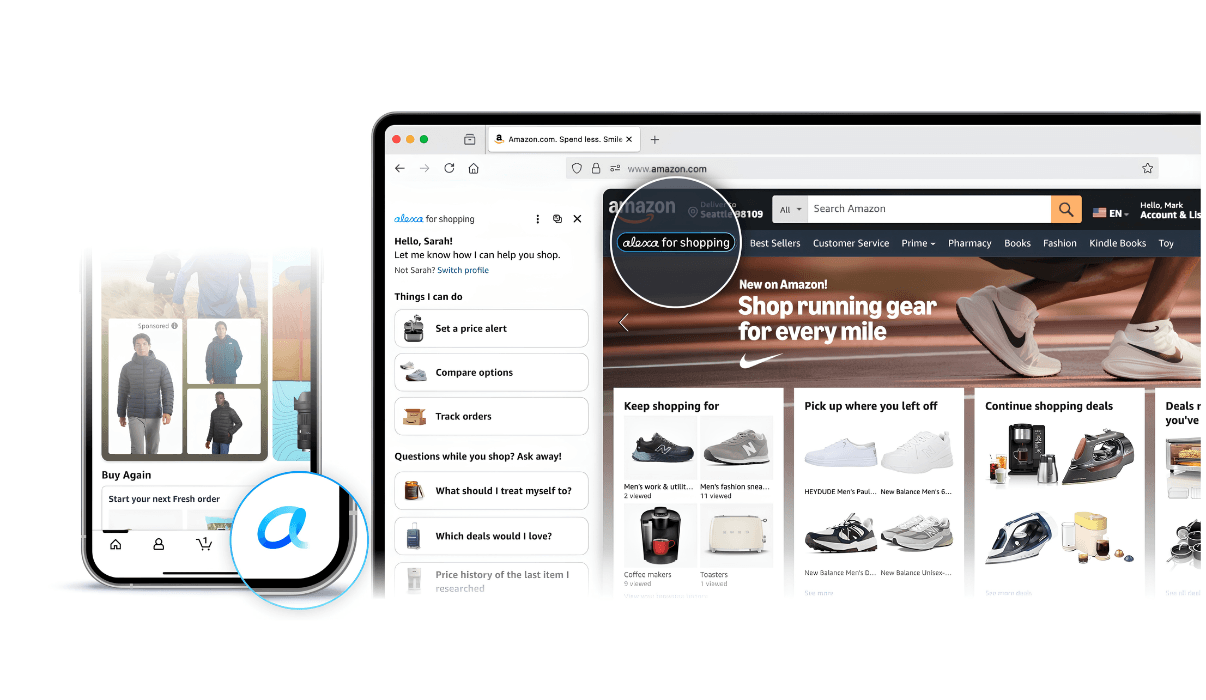
Example: Amazon’s shopping assistant reached 300 million customers in 2025 and was on track to drive ~$10 billion in incremental annual sales, according to CEO Andy Jassy on the company’s Q3 2025 earnings call. In May 2026, Amazon retired the standalone “Rufus” brand and folded it into a new agent called Alexa for Shopping, which sits inside the main Amazon search bar and can now compare products, track a year of price history, and, through a feature called “Buy for Me,” complete purchases on the shopper’s behalf. Sponsored placements now compete for attention inside an agentic conversation, not just a ranked search results page.
More AI inside the ad platforms
Bidding, creative, and audience-building are moving to the platform’s own AI, so the bar for optimization is higher.
Example: Google is replacing legacy Dynamic Search Ads with AI Max, an AI-powered campaign framework that automatically expands search coverage, generates creative variations, and determines landing pages using broader intent signals. According to Google, advertisers using the full AI Max feature set achieved an average 7% increase in conversions or conversion value at similar CPA or ROAS levels. The shift reflects a broader industry trend in which campaign optimization is increasingly handled by platform AI rather than manual advertiser controls.
Commerce media beyond retailers
Banks, payment platforms, and travel brands are building their own networks using their purchase data. In October 2025, Mastercard launched Mastercard Commerce Media, a commerce media network that uses consented transaction data to help advertisers reach consumers across banking and publishing environments. The company said the platform supports more than 25,000 advertisers and 500 million enrolled consumers, demonstrating how commerce media is expanding beyond retailers into financial services and other industries.
Off-site and CTV are growing fastest
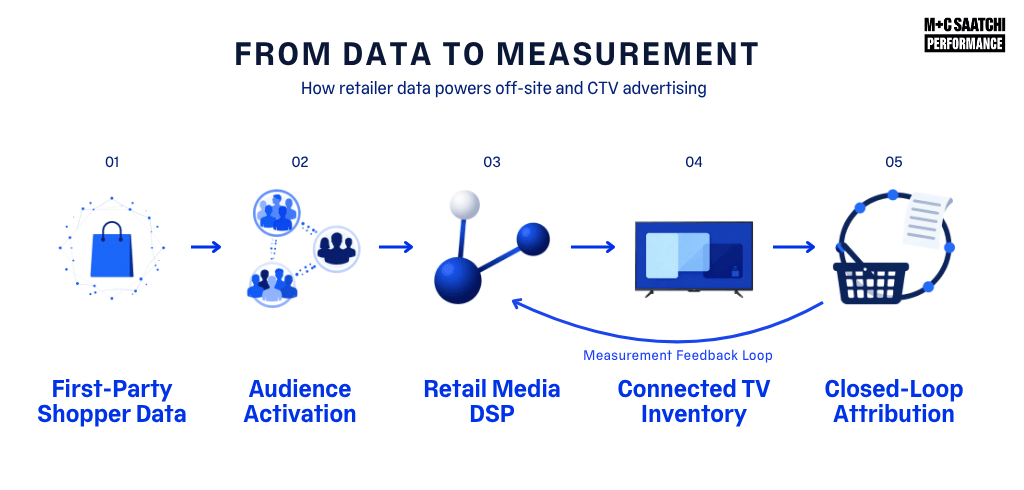
More ad budget is moving into connected TV and off-site programmatic, where retailers can use their own shopper data to reach people beyond the store shelf. According to Skai’s 2026 State of Retail Media Report, 52% of advertisers said they are shifting display spend from open-web DSPs to retail media DSPs. The main reason they gave was closed-loop attribution (57%), which traditional programmatic can’t provide.
Example: Walmart Connect expanded its off-site retail media offering in 2026 by making Walmart audiences and closed-loop measurement available through external buying platforms, beginning with Yahoo DSP and VIZIO connected-TV inventory. The move allows advertisers to use Walmart’s first-party shopper data beyond Walmart-owned properties while continuing to measure campaign performance against retail outcomes. This reflects a broader industry shift toward extending retail media into CTV and programmatic environments rather than limiting campaigns to retailer websites and apps.
How Should You Evaluate a Retail Media Agency in 2026?
Many retail media agencies describe similar capabilities. A more useful evaluation focuses on how they operate, what they can demonstrate, and how they measure results.
1. Multi-network experience
Ask the agency to provide examples of campaigns run across multiple retail media networks. Look for direct experience with platforms such as Amazon Ads, Walmart Connect, Instacart Ads, and Target Roundel. If your business operates internationally, ask about work completed on regional networks, including Flipkart, Tesco Media and Insight Platform, Nectar360 (Sainsbury’s), or Coupang Ads.
The goal is to determine whether the agency can manage campaigns across different retail ecosystems rather than relying on a single network.
2. Incrementality measurement
Incrementality now sits third in how budgets get weighted, but 75% of advertisers say they can’t measure it well. Reporting sales or return on ad spend does not show whether advertising created additional demand. Ask how the agency measures incrementality and whether it conducts controlled testing.
Examples include:
- Geo-lift tests
- Holdout groups
- Matched-market experiments
- Marketing mix modeling (MMM)
You should also ask how test results are used when making budget allocation decisions.
3. First-party data activation
As third-party cookies become less important, many advertisers are increasing their use of first-party customer data.
Ask the agency:
- How audiences are built from shopper and customer data
- Whether clean-room environments such as Amazon Marketing Cloud (AMC) are part of its measurement approach
- How audience insights are extended to offsite media channels
- How customer data is connected to campaign reporting
The objective is to understand how data is used beyond onsite retail media placements.
4. AI and agentic commerce preparedness
About 68% of retail executives plan to use agentic AI within the next 12 to 24 months, according to Deloitte’s agentic AI retail research. Ask how the agency is adapting to AI-driven shopping experiences and automated commerce environments.
Areas to discuss include:
- Product feed management
- Structured product attributes
- Content optimization for AI-powered search and discovery systems
- Use of AI in campaign management and bid optimization
- Internal processes for testing and monitoring AI-generated recommendations
The focus should be on operational capabilities rather than general statements about AI adoption.
5. Omnichannel execution
Retail media increasingly extends beyond sponsored search placements. Ask whether the agency manages campaigns across:
- Retail media networks
- Connected TV (CTV)
- Social commerce platforms
- Display advertising
- Video advertising
Also ask how performance is measured across channels and whether reporting connects media exposure to downstream shopping or purchase behavior.
6. Reporting transparency and pricing
IAB Australia found that 48% of buyers put ad-effectiveness measurement and performance transparency in their top two reasons for picking a retail media partner. Request a sample reporting dashboard and a clear explanation of how fees are structured.
Questions to ask include:
- Which performance metrics are reported regularly?
- How often are reports delivered?
- What level of campaign detail is available?
- Are there platform fees, media commissions, or technology costs?
- How are recommendations linked to reported outcomes?
A clear reporting process and transparent pricing structure make it easier to compare agencies and evaluate performance over time.
Final checklist
Before selecting a retail media agency, verify that it can demonstrate:
- Experience across multiple retail media networks
- A documented approach to incrementality testing
- First-party data and clean-room capabilities
- Practical use of AI in campaign operations
- Cross-channel media execution
- Transparent reporting and fee structures
These areas provide a more reliable basis for evaluation than agency size, awards, or sales presentations.
The 10 Best Retail Media Agencies to Watch in 2026
1. M+C Saatchi Performance
Company: M+C Saatchi Performance is a digital marketing agency within the M+C Saatchi Group. Founded in 2006 as a mobile marketing specialist, the agency now operates from offices in Bangalore, Bangkok, Delhi, Dubai, Jakarta, Kuala Lumpur, London, Los Angeles, Manila, Mumbai, New York, Singapore, and Sydney.
Retail media specialties: The agency offers a complimentary Retail Media Audit that is completed over 10 business days. The process includes four stages: discovery, data access, audit, and a delivery workshop. Clients receive a 20-30 slide report together with a 30-60-90-day action plan.
Its retail media work covers account structure reviews, bidding strategy analysis, product detail page optimization, creative asset assessment, category benchmarking, competitor reviews, and performance measurement. The agency evaluates metrics such as return on ad spend (ROAS), advertising cost of sale (ACOS), click-through rate (CTR), and conversion rate.
Best for: Brands seeking a detailed retail media audit alongside ongoing performance marketing support.
2. Publicis Groupe
Company: Publicis Groupe has expanded its commerce and retail media capabilities through several acquisitions. In 2021, it acquired CitrusAd, a retail media technology platform. In 2022, it added Profitero, a digital shelf analytics provider. And in September 2024, Publicis acquired Mars United Commerce, a commerce marketing and shopper marketing agency. Mars United continues to operate within the Publicis Commerce organization.
Retail media specialties: Publicis Commerce works across retail media strategy, analytics, content, digital commerce, and retail consulting. Its capabilities include retail media technology through CitrusAd, digital shelf measurement through Profitero, data and identity solutions, and commerce marketing services through Mars United. Publicis is also involved in Unlimitail, a retail media venture with Carrefour, which works with JCDecaux to develop and sell advertising inventory across shopping center media networks in France and Spain.
Best for: Large brands seeking access to retail media technology, digital shelf analytics, commerce strategy, and shopper marketing services from a single provider.
3. Flywheel (Omnicom Commerce)
Company: Flywheel is Omnicom’s commerce and retail media division. Omnicom acquired the business from Ascential in 2024.
Retail media specialties: Flywheel manages retail media campaigns across approximately 400 marketplaces and retail media networks. The company states that it works with more than 50 of the world’s 100 largest publicly listed CPG companies and has around 4,500 commerce specialists worldwide.
Best for: Large brands looking for a retail media agency with global scale and broad marketplace coverage.
4. VML Commerce
Company: WPP launched its Commerce Practice in April 2026. The practice brings together commerce-related capabilities from VML, WPP Media, and other WPP agencies. Brent Taylor leads the organization globally, while Samantha Bukowski serves as global president of WPP Commerce and WPP Media.
Retail media specialties: Commerce media, shopper marketing, creative commerce, content, and retail activation services delivered through a unified WPP structure.
Best for: Brands seeking integrated commerce, media, and creative services within a single agency network.
5. Merkle & Dentsu
Company: Dentsu’s commerce offering is primarily housed within Merkle, its customer experience and CRM agency. Merkle expanded its commerce capabilities through the acquisition of LiveArea in 2021, which brought expertise in customer experience and the Salesforce, Adobe, and SAP platforms.
Retail media specialties: Using first-party customer data and retailer clean-room environments such as Amazon Marketing Cloud and Walmart Data Ventures to support audience planning, targeting, and measurement.
Best for: Companies that place a strong emphasis on CRM, customer data, and audience strategy in their retail media programs.
6. Havas Market
Company: Havas Market is the commerce division of Havas Media Network. Havas N.V. became an independently traded company on Euronext Amsterdam in December 2024 following its separation from Vivendi. In February 2025, Havas acquired a majority stake in Channel Bakers, an Amazon-focused agency that continues to operate under its existing brand.
Retail media specialties: Through Channel Bakers, Havas Market provides Amazon advertising and marketplace services. The broader Havas Market organization reports operations across 27 countries and a team of more than 600 retail media specialists.
Best for: Brands seeking Amazon marketplace expertise backed by the resources of a global media network.
7. Tinuiti
Company: Tinuiti is an independent U.S. agency formed in 2018 through the merger of several performance marketing companies, including Elite SEM and Ampush. The agency operates from offices in major U.S. cities such as New York and Atlanta.
Retail media specialties: Tinuiti manages retail media programs across Amazon, Walmart, and Instacart. Its commerce practice is supported by Bliss Point, a measurement platform added through an acquisition in 2021. The agency is a Walmart Advertising Partner and publishes an annual Digital Ads Benchmark Report. Tinuiti reports more than $4 billion in managed media spend and a workforce of over 1,200 employees.
Best for: U.S. focused brands that need retail media support across Amazon and Walmart.
8. Kepler Group
Company: Kepler Group is an independent agency founded in 2012 and part of the kyu collective. The company has roughly 600 employees across ten offices.
Retail media specialties: Kepler works extensively with Amazon DSP and off-site retail media campaigns. Its proprietary platform, Kip, supports audience management, media buying, creative workflows, and measurement. The company has also introduced Kip AIR, a tool designed to track brand visibility within generative AI platforms.
Best for: Brands interested in combining Amazon media execution with proprietary technology and AI-focused measurement tools.
9. Acadia
Company: Acadia is an independent agency based in Atlanta. It was founded in 2021 by Sean Belnick and Jared Belsky, the former CEO of 360i. In April 2025, Acadia acquired Crush, an Amazon-focused accelerator agency.
Retail media specialties: The agency provides Amazon Marketing Cloud analysis, sponsored advertising management, and product page optimization. Its retail media team organizes services around specific product categories, including health and beauty, home, and food brands.
Best for: AmMid-market brands looking for marketplace support on Amazon and Walmart, particularly those with category-specific requirements.
10. Podean
Company: Podean is backed by Mountaingate Capital. The agency has expanded through several acquisitions, including Commerce Canal in August 2025, Ad Advance in February 2026, and Amerge in April 2026.
Retail media specialties: Podean works across more than 110 online marketplaces and over 50 retail media networks. Its coverage includes Amazon, Walmart, Costco, Target, Instacart, and Mercado Libre. The company holds Advanced Amazon Partner status and provides marketplace management, DSP services, analytics, and retail media support.
Best for: Brands that sell across multiple marketplaces and retail media networks and need a single agency partner to manage them.
Checklist: 8 Questions to Ask Your Retail Media Agency
Use these questions to separate genuine retail media specialists from generalists before you sign.
- How many retail media networks do you actively execute on, and can you show live examples across each?
- How do you measure incrementality, and can you share a documented geo-lift or holdout framework?
- How do you activate first-party shopper data through clean rooms such as Amazon Marketing Cloud?
- How are you preparing our product data for agentic commerce and LLM-driven discovery?
- How do you execute across off-site programmatic, CTV, and in-store, not just sponsored search?
- What is your reporting cadence, and how transparent is your ad tech and attribution fee structure?
- Which documented client outcomes can you share for brands of our size and category?
- What does the first 90 days look like, and how quickly can you prove value?
Choose the Partner That Ties Ad Spend to Real Sales
By 2026, retail media is more than a channel. It’s the layer that links shopper data, media, and sales. The agencies that win will be the ones that can prove incrementality, run campaigns together across on-site, off-site, CTV, and in-store, and get their clients agent-ready before agentic commerce takes hold.
If you want a partner with independent global recognition, documented retail media outcomes for large CPG, beauty, and D2C brands, and a way to prove value in the first 10 business days at no cost, start with the free M+C Saatchi Performance Retail Media Audit. Our specialists will benchmark your current marketplace performance, spot inefficiencies and competitor gaps, and hand you a 30-60-90-day roadmap tied directly to sales impact.
Start Your AuditFrequently Asked Questions
Retail media is paid advertising placed at or near a retailer’s point of purchase, including on-site sponsored search, on-site display, retailer-powered off-site programmatic, connected TV, and in-store digital signage, powered by the retailer’s first-party shopper data. In 2026, global retail media ad spend is forecast to reach $196.7 billion, roughly 16% of all global ad spend.
Retail media is a subset of commerce media. Commerce media is the broader umbrella that also includes non-retailer commerce-data-driven advertising, such as payment platforms (PayPal), financial institutions (American Express), and delivery services using purchase behavior for targeting. Retail media specifically refers to advertising owned by a retailer.
Skai’s 2026 State of Retail Media Report finds that brands plan to work with 8 retail media networks by end-2026 on average, yet only 12% have integrated media + commerce operations internally. A specialist agency provides multi-network execution, measurement infrastructure, incrementality testing, and clean-room expertise that most in-house teams can’t match without significant investment.
The five most important trends are:
- Agentic commerce and LLM-driven discovery
- Retailer-powered shopping agents like Amazon Rufus
- Tighter AI integration inside retail media platforms
- Retail media expanding beyond retail (financial, payments, travel)
- Offsite + CTV as the highest-growth surfaces.
At minimum: an AI-powered ad server with vector search, a self-serve advertiser interface, a retail DSP for off-site inventory, a clean-room capability (Amazon AMC, Walmart Data Ventures) and structured product-data infrastructure for LLM and agent readability.