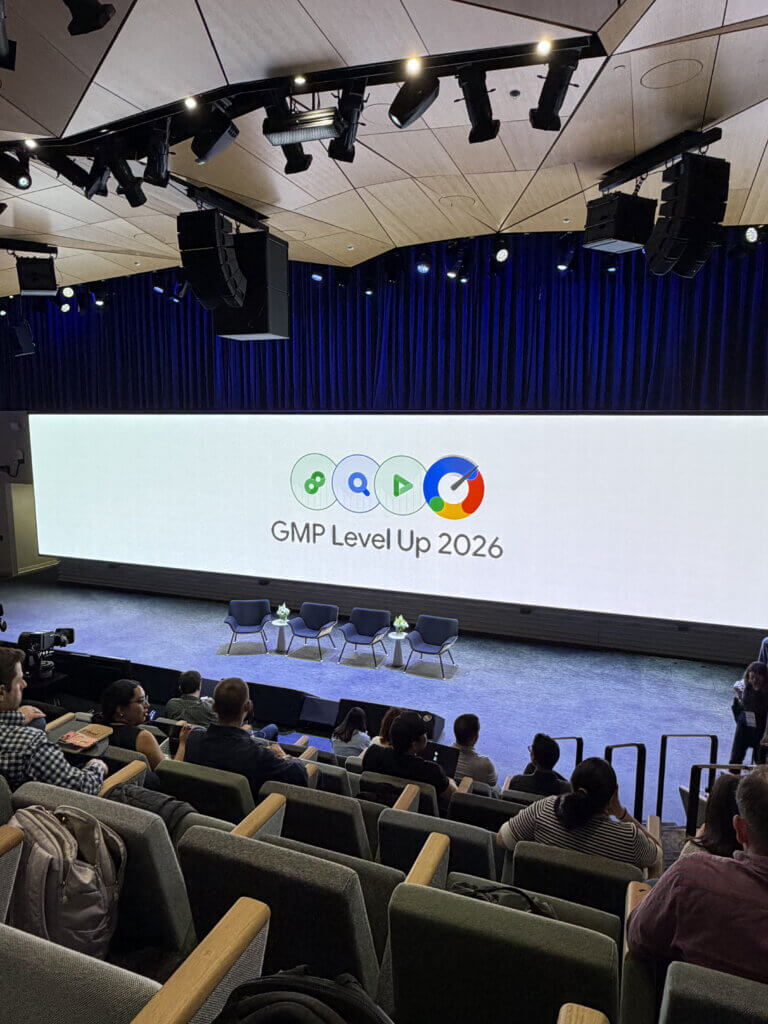
I recently had the privilege of attending Google’s GMP (Google Marketing Platform) ‘Level Up NYC 2026′ event, an annual flagship gathering that brings together marketers, strategists, and platform specialists for an in-depth and hands-on look at the future of the GMP ecosystem. The session offered both technical and strategic insights into the latest innovations across elements of the Google product suite, for example, Campaign Manager 360, Search Ads 360, and Display & Video 360 (DV360).
The event was a precursor to the flagship Google Marketing Live event, and the purpose of the more specific ‘Level Up NYC 2026’ event is to enable digital marketers to stay ahead of the curve and focus on how brands can better engage audiences across every digital touchpoint, powered by what Google calls the “Gemini Advantage.” From platform updates and automation capabilities to AI-driven optimization and measurement strategies, GMP Level Up showcased how the next evolution of marketing technology is shaping campaign execution and customer engagement.
As a Programmatic Strategist, I was especially interested in discussions around DV360, and here are some of my key takeaways from that portion of the event.
1) The “Gemini Advantage” is more than just automation. It’s decision-making.
The biggest shift isn’t that DV360 has more AI. It’s that Gemini is being embedded directly into how media is planned, activated, and optimized.
Examples:
Live inventory (especially sports) is now actually biddable and optimizable in real time
Marketplace discovery is becoming AI-assisted (not just a static deal library)
Publisher data matching is evolving into a more privacy-safe but still powerful ecosystem
Why does this matter for marketers?
This is Google moving from “AI as a feature” to “AI as the interface.” The workflow itself is becoming the product.
Instead of marketers manually navigating platforms, pulling reports, adjusting bids, or sorting through inventory, AI is increasingly becoming the layer that interprets signals, recommends, or even executes the next action. That fundamentally changes how campaigns are managed day to day.
For marketers, the benefit is speed and scalability. Teams can react to live moments faster, uncover inventory opportunities more efficiently, and spend less time on manual optimization. This becomes especially important in environments such as live sports or cultural events, where timing directly affects performance.
There is an operational shift happening here: marketers will need to become more comfortable guiding AI systems rather than manually controlling every lever themselves. The role evolves from “platform operator” to “strategic decision-maker.”
However, as automation increases, transparency and oversight become even more important. Marketers will need strong measurement frameworks, clear business goals, and high-quality first-party data to ensure the AI is optimizing toward the right outcomes, not just platform efficiency metrics.
2) The real unlock: AI tools that reduce operational friction.
The event showcased a demonstration of two new features coming to DV360: Ads Advisor and Campaign Builder.
What are these new tools?
Ads Advisor explains why creatives are rejected and how to fix them. Additionally, it provides rich performance insights, campaign improvement recommendations, and data visualizations. It also serves as a QA assistant, ensuring that the campaigns are correctly set up the way you want them to be.
With Campaign Builder, you can upload a media plan and the tool will visualize your campaign structure in a sandbox environment that the user can review, and then it will create the campaign for you.
Why does this matter for marketers?
This is Google seeking to reduce one of the biggest hidden costs in programmatic: time and human error.
This matters because, if execution becomes faster and cleaner the following can occur:
Agencies scale more easily
Junior talent ramps up faster
Strategy becomes the differentiator (not trafficking)
This is important because much of programmatic work today remains operationally heavy. Manual intervention is required for troubleshooting creative approvals, manually building campaigns, QAing setups, and fixing avoidable errors. These tasks are necessary, of course, but they’re not strategic; strategic decision-making should be what really delivers success against the competition.
If tools like Ads Advisor and Campaign Builder work practically as intended, they could significantly reduce campaign setup time and lower the risk of execution mistakes that impact pacing, delivery, or measurement. That means teams can spend more time analyzing performance, testing strategy, and driving business outcomes, all of which will benefit advertisers.
There’s also a talent implication here. As AI handles more of the execution layer, the skills that become most valuable are strategic thinking, cross-channel planning, data interpretation, and client communication. The industry may start valuing “systems thinking” over purely platform-specific expertise.
One consideration, though, is that increased automation could create overreliance on platform recommendations. This is where human expertise and analytical thinking become vital. Marketers still need to understand campaign structure, measurement methodologies, and media fundamentals to validate whether AI-generated recommendations are actually aligned with campaign goals.
3) Performance is increasingly becoming a reflection of how effectively you leverage AI.
At the event, Google discussed results such as an ROI of 120% from AI campaign optimization. The caveat is that results such as this can only be achieved if AI is embedded directly into planning, activation, optimization, and execution.
In other words, when the system both decides and executes, underperformance is no longer blamed on tools—it’s attributed to how well you’re using them.
That’s a meaningful shift.
It puts pressure on advertisers to fully adopt the following:
AI-driven bidding and optimization
First-party data integration
Cross-channel orchestration within a single ecosystem
Not as enhancements, but as the baseline.
Why does this matter for marketers?
The advertisers who win won’t just “use DV360.” They’ll lean into the system’s strengths, leveraging AI not just to execute faster but also to make better decisions at scale.
What stood out to me most is that AI is no longer being positioned as a competitive advantage; it’s being positioned as the default operating model. The gap between advertisers may increasingly come down to how effectively they feed data into these systems, structure campaigns for machine learning, and interpret the outputs.
For marketers, this raises both opportunities and challenges. On one hand, AI-driven optimization can unlock stronger performance, faster learning cycles, and more efficient media buying at scale. On the other hand, it increases dependence on platform ecosystems and makes data quality more important than ever.
Advertisers with strong first-party data strategies, clean conversion tracking, and integrated measurement frameworks will likely benefit most. Meanwhile, brands with fragmented data or siloed channel strategies may struggle to fully capitalize on these AI-driven workflows.
Ultimately, the conversation is shifting from “Should we use AI?” to “How do we operationalize AI effectively across planning, activation, measurement, and optimization?” That feels like the real industry transition happening right now.
In Summary
Google’s GMP ‘Level Up NYC 2026′ event made one thing clear: DV360 is no longer just a buying platform; it’s becoming an AI-powered decision engine for programmatic marketing.
The real question isn’t whether these features exist; it’s how well teams are able to take advantage of them through combining human expertise and machine efficiencies.